
Improve renewals. Make staying worth it.
Mind Technology helps UK professional bodies, medical and scientific societies, trade associations and membership organisations understand why members disengage, strengthen year-round value and build renewal journeys that begin long before the renewal notice arrives.
Renewal is not decided when the invoice arrives.
It is influenced by every useful interaction, unanswered need, event, email, educational experience and moment of participation that happens before it.
The renewal notice is often where the problem becomes visible.
But the underlying causes may have developed months earlier. Effective retention work therefore starts with understanding the complete member experience.
Members forget why they joined.
Benefits may exist, but if they are not experienced or repeatedly connected to member priorities, perceived value can gradually disappear.
Engagement becomes concentrated around one event.
A congress may be highly valuable, but the relationship becomes vulnerable if there are few meaningful touchpoints throughout the rest of the year.
Every member receives the same experience.
Early-career professionals, senior experts, international members and institutional members may value entirely different parts of the organisation.
Renewal becomes a transactional campaign.
Reminder emails can support conversion, but they cannot compensate for a year in which the member did not clearly experience value.
Retention protects more than membership income.
A retained member may also participate in events, education, committees, networks, advocacy, research and professional communities.The value of the relationship is therefore broader than the membership fee itself.
Start retention on day one.
The strongest renewal journey makes value visible continuously rather than concentrating all communication around an annual deadline.
Welcome
Confirm why joining was a good decision.
Activate
Help members experience useful benefits quickly.
Personalise
Connect members with what matters to them.
Engage
Build repeated reasons to participate.
Reinforce
Make accumulated value visible.
Renew
Make continuation the logical next step.
Deepen
Grow participation after renewal.
Members often disengage before they leave.
The exact signals depend on your technology and available data, but behavioural patterns can help identify where engagement is weakening.
Communication engagement falls.
Reduced email activity, fewer website visits or lower interaction with content may indicate declining relevance.
Members stop using educational benefits.
Courses, webinars, guidelines and learning resources can provide useful evidence of whether members are actively receiving professional value.
Participation decreases.
Reduced attendance or registration can indicate changing needs, financial barriers or a weaker relationship with the organisation.
Members stop contributing.
Reduced committee, network, volunteer or community participation may indicate that belonging has become less meaningful.
Member circumstances change.
Career stage, geography, employment or professional interests can change the benefits members need.
Previous renewal behaviour shows friction.
Late renewal, repeated reminders or previous lapses can help identify segments that may require a different retention approach.
Build the system behind retention.
Retention & Member Analysis
Analyse member segments, renewal history, participation, engagement and available behavioural signals to identify potential retention patterns.
Member Value Architecture
Clarify which benefits matter to different members and how those benefits should be communicated throughout the year.
Member Onboarding
Design the first weeks of membership around early value, useful actions and discovery of the organisation's most relevant benefits.
Year-Round Member Journeys
Connect content, events, education and community opportunities into a more intentional participation rhythm.
Renewal Campaigns
Build segmented renewal communication around value, timing, friction reduction and clear calls to action.
Lapsed Member Reactivation
Understand why relationships ended and create structured win-back journeys around relevant changes, benefits and opportunities.
Stop sending the same reminder to everyone.
Renewal communication can reflect member behaviour, segment, value usage and relationship history rather than operating as one generic countdown.
A lost renewal does not always mean a lost relationship.
Reactivation works better when the organisation understands why the member left rather than simply repeating the original offer.
Why did they lapse?
Cost, time, career change, geography, unclear value and low usage require different responses.
Do not treat all lapsed members alike.
Segment by member type, engagement history, tenure and known reason for leaving.
Give them a new reason to return.
New education, events, benefits, networks or organisational changes may reopen the relationship.
Feed the insight back into retention.
Lapsed-member research should improve the experience for members who have not yet left.
Renewal rate is an outcome. Measure what drives it.
Better retention starts with understanding the member.
Turning audience information into membership strategy
Mind Technology analysed audience demographics, professional experience, educational preferences, event participation, communication channels, membership value and barriers to participation.The objective was to understand where the society could strengthen relevance, accessibility and long-term engagement.
Members do not all perceive value in the same way. Better segmentation, easier access to expertise, year-round education and stronger engagement pathways can make the association relationship more relevant across different career stages and professional needs.
Understand barriers to participation
Research helps distinguish communication problems, accessibility problems, value problems and structural barriers.
Extend value beyond the congress
Education, content and digital communication can connect the moments between major events and strengthen the ongoing member relationship.
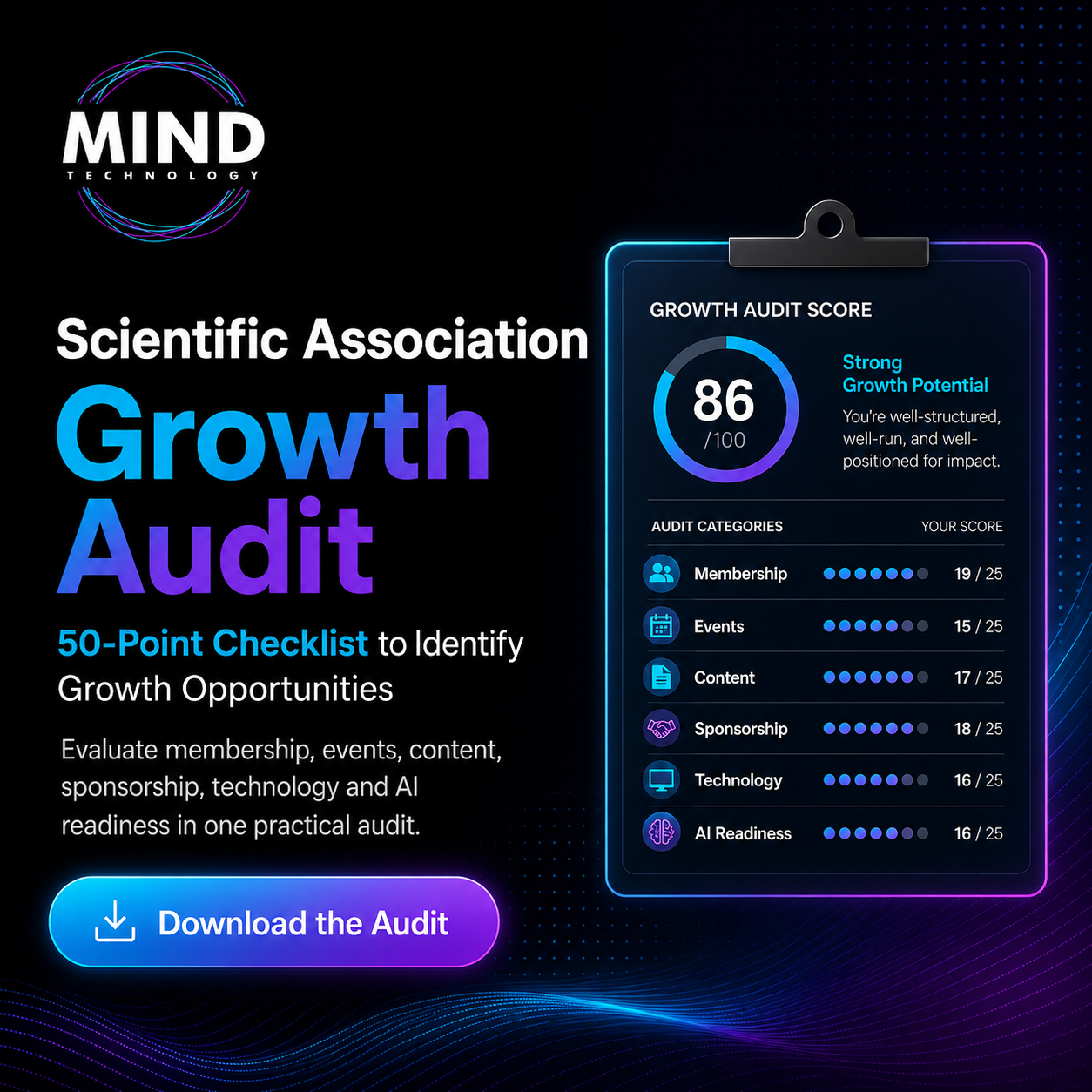
Where is your member relationship losing momentum?
Use the Scientific Association Growth Audit to evaluate the wider systems affecting membership, engagement, events, communication, technology and long-term organisational growth.
Common questions about improving renewals.
Can you help us improve renewal rates?
Yes. We look beyond the final renewal campaign to understand onboarding, member value, engagement, communication, segmentation, friction and lapsed-member behaviour across the complete lifecycle.
What if we do not have sophisticated member data?
We can begin with the information you already have: membership records, renewal history, event participation, email data, survey responses, website behaviour and qualitative feedback. The objective is to improve the decision system progressively rather than wait for perfect data.
Can you help us redesign our renewal email campaign?
Yes, including segmentation, timing, messaging, automation and conversion paths. However, we would also examine whether the organisation is communicating value sufficiently before the campaign begins.
Can you help with members who have already lapsed?
Yes. Lapsed-member journeys can combine research, segmentation, updated value propositions and targeted reactivation communication.
Can you work with our existing CRM or association management system?
Yes. We normally begin with the systems already in place and determine how data, automation and communication can better support the member journey before recommending unnecessary replacement.
Does this require changing our membership benefits?
Not always. Sometimes the value already exists but members are not discovering, using or recognising it. Other situations may reveal genuine gaps in the proposition. The diagnosis should determine which problem you actually have.
Can you work alongside our membership team?
Yes. Mind Technology can operate as a strategic and execution partner alongside membership, marketing, leadership, association management companies, CRM providers and existing agencies.
Should retention and acquisition be managed separately?
They require different tactics, but they should be connected. What the organisation promises during acquisition must be delivered after someone joins. Retention therefore begins with the expectations created before membership starts.
Do not wait until renewal season to prove membership is valuable.
If your organisation is facing falling renewals, inactive members, weak engagement or increasing pressure to demonstrate membership value, we can start by identifying where the member relationship is losing momentum.