
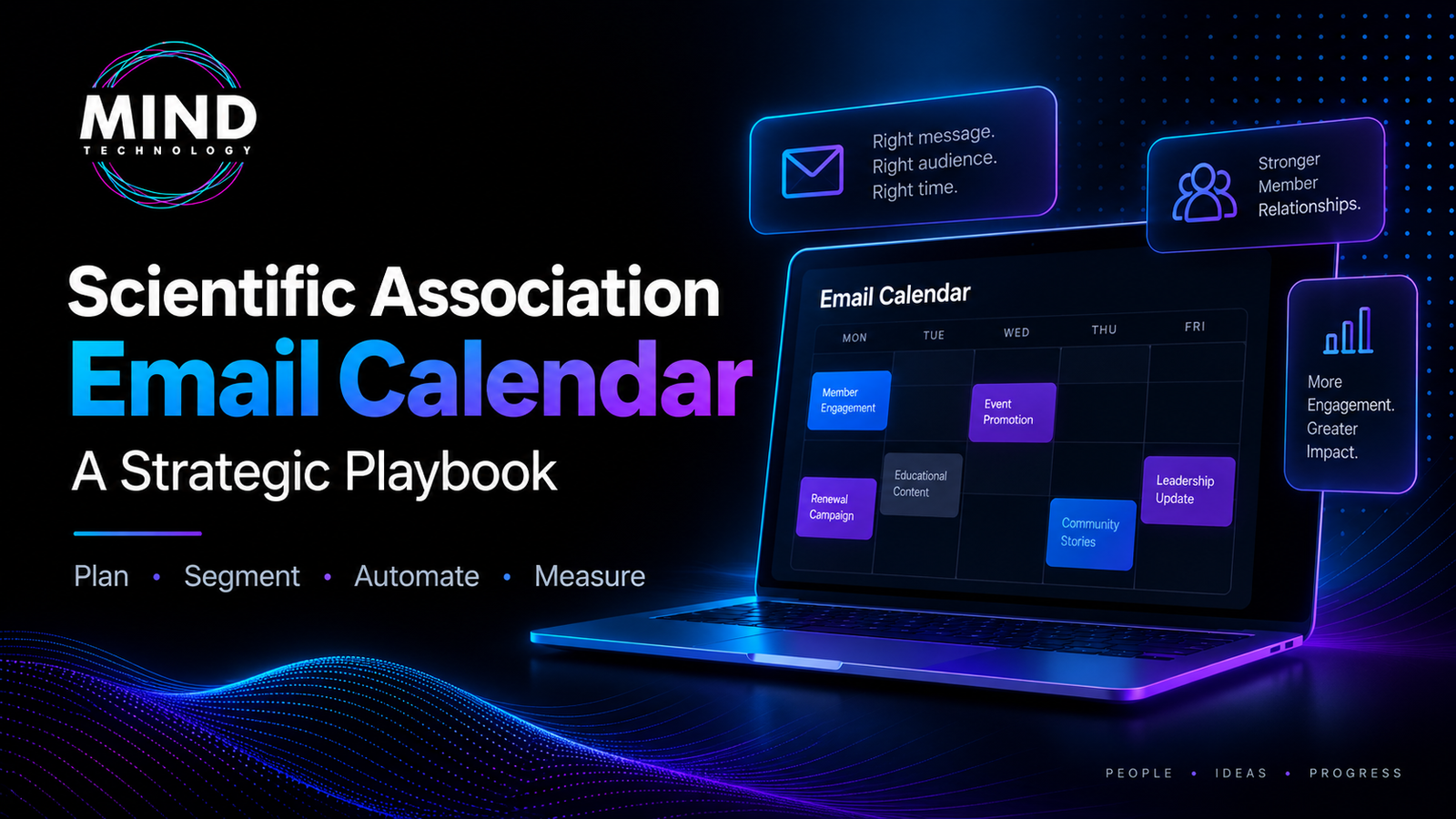
Email is often one of the most important communication channels available to a scientific association, but it can also become one of the easiest channels to manage reactively. Announcements are added at the last minute, different departments compete for the same audience, and performance is measured campaign by campaign rather than as part of a wider member relationship.
The Scientific Association Email Calendar: A Strategic Playbook was created to move beyond that model. Its central idea is simple: an email calendar should not be an administrative schedule of sends. It should become a shared planning system that connects organisational goals, audience segments, lifecycle automation, events, content and execution.
The playbook is structured around seven practical steps, moving from planning and measurement through segmentation, automation, event promotion, cadence, seasonal planning and operational discipline.
Start with one shared planning hub
The first structural shift is moving away from ad-hoc email sends toward a centralised calendar. A shared calendar gives communications teams, membership teams, education staff, event teams and leadership visibility into what is being sent, to whom, when and why.
That visibility matters because email volume is not only an operational question. Over-scheduling can affect engagement, deliverability and the reputation of the association’s sending programme.
Every send should have a reason, an audience and an owner.
A centralised calendar becomes the common operating view for the entire organisation.
The calendar should also capture consistent metadata. Recording the campaign type, target segment and primary objective makes later reporting much more useful because the organisation can analyse patterns rather than isolated sends.
A useful email calendar does more than tell you what is being sent. It tells you why it is being sent and what success should look like.
Step 1: Define goals before writing subject lines
The playbook argues that every campaign should trace back to an organisational objective. Event registrations, renewals and educational engagement require different messages, different calls to action and different definitions of success.
The problem with ambiguous objectives is that they produce ambiguous reporting. If the organisation has not decided what an email is supposed to achieve, it becomes difficult to know whether the campaign worked.
Registration, renewal, participation, education or another measurable member action.
Clicks, conversions, renewal completions and event registrations provide stronger signals than list size alone.
The playbook uses open rate and click-through rate as reference points, but places greater emphasis on metrics tied to actual member behaviour: clicks, conversions, completed renewals and registrations.
Raw list size can be misleading. A large database can coexist with declining relevance if fewer people are opening, clicking or taking action.
Step 2: Stop treating every member as the same person
Generic broadcasts are easy to execute, but they ignore the context that makes communication relevant. Members can differ by engagement level, career stage, renewal timing and previous behaviour.
Segmentation allows the calendar to become more precise. Instead of deciding only what to send, the association begins deciding who needs which message at which moment.
Different engagement states require different messaging and re-engagement approaches.
Professional needs change across mentorship, networking, expertise and recognition.
Expiration proximity can trigger communication at the moment it is most relevant.
For early-career members, mentorship, networking and professional development may be highly relevant. Senior members may respond differently to thought leadership, contribution or recognition opportunities.
The same principle applies to renewal. A member approaching expiration should not receive the same message as a recently renewed member.
Step 3: Build a member lifecycle engine
Automation is not valuable because it removes people from communication. It is valuable because it allows the association to deliver relevant communication consistently at moments that would otherwise depend on manual intervention.
The playbook identifies three high-value lifecycle automations: onboarding, renewal and win-back.
A 30-day welcome sequence introducing benefits, connections and early engagement opportunities.
A five-touch sequence beginning 90 days before expiration to reinforce value and reduce friction.
Learn why members left, then reconnect them with relevant changes, value and re-entry opportunities.
Onboarding
The playbook recommends a 30-day welcome sequence that helps new members understand benefits, connect with relevant communities and take useful early actions.
Renewal
Renewal communication should begin before the final reminder. The suggested framework starts 90 days before expiration and uses several touches to reinforce value, show impact and make the renewal decision easier.
Win-back
Lapsed members can provide valuable information about why the relationship ended. A win-back sequence can begin with feedback and then introduce relevant changes or opportunities rather than simply repeating the original membership pitch.
Step 4: Promote events through a sequence, not an announcement
A major scientific meeting rarely succeeds because of one announcement email. Event promotion works across a journey: awareness, interest, consideration, urgency and final action.
The playbook uses a five-touch framework for event promotion.
Each message has a different role. Repeating the same event announcement five times is not a five-touch strategy. The content should evolve as the audience moves closer to the decision.
Step 5: Establish a predictable communication rhythm
Members are busy professionals. A calendar helps prevent long periods of silence followed by bursts of promotional communication.
A predictable rhythm creates space for a healthier content mix: educational value, community connection and promotion.
Research insights, professional knowledge, best practices and thought leadership.
Member stories, chapter news, peer connections and community participation.
Events, renewals and relevant offers supported by clear calls to action.
The objective is not to follow an arbitrary frequency. It is to create a rhythm that is predictable enough to coordinate internally and consistent enough to build audience expectations.
Step 6: Plan in seasonal arcs, not month by month
A strategic calendar should look beyond the next send. The playbook recommends planning in broader seasonal arcs so there is enough time for creative development, offer construction, event promotion and internal approval.
Use industry peaks, educational content and early conference registration before seasonal attention begins to drift.
Address early-career transitions and prepare late-year campaigns early enough to avoid rushed execution.
Use impact stories, renewal communication and year-end giving or donation activity where relevant.
The value of seasonal planning is not the calendar itself. It is the ability to prepare the message, audience, creative assets and internal approvals before the organisation reaches a deadline.
Step 7: Turn the calendar into an operating system
A detailed calendar still fails if ownership is unclear. The final step of the playbook focuses on workflow discipline: named owners, review rhythms and continuous optimisation.
Copy, design, approval and scheduling each need a named owner and deadline.
Use a short weekly review to confirm the next two weeks of scheduled sends.
Test subject lines and preheaders on major campaigns.
Build a living library of what works and apply those insights to future campaigns.
The playbook proposes a 15-minute weekly review focused on the next two weeks of communication. That small operational habit can surface conflicts and blockers before they become last-minute problems.
Testing also needs continuity. A/B testing becomes much more valuable when the lessons are retained and reused rather than forgotten after each campaign.
The calendar is member-relationship infrastructure
The underlying argument of the playbook is that email should not be treated as a sequence of unrelated broadcasts. Each message is a touchpoint in an ongoing relationship with the member.
A well-managed calendar creates the structure needed to make that relationship more deliberate: the organisation knows who it is communicating with, why the message matters, which stage of the lifecycle it supports and what behaviour should happen next.
Communicate professionally but personally. Treat members as colleagues you are helping, not records in a database.
Test, measure and refine. Let member behaviour inform what should change next.
Use the calendar to deepen the relationship between the association and its members over time.
Your email calendar is not an administrative tool. It is part of the infrastructure through which your association builds and maintains member relationships.
Download the Scientific Association Email Calendar
The complete playbook contains the seven-step framework for building a more coordinated email programme, including segmentation, lifecycle automation, event promotion, cadence, seasonal planning and workflow discipline.
